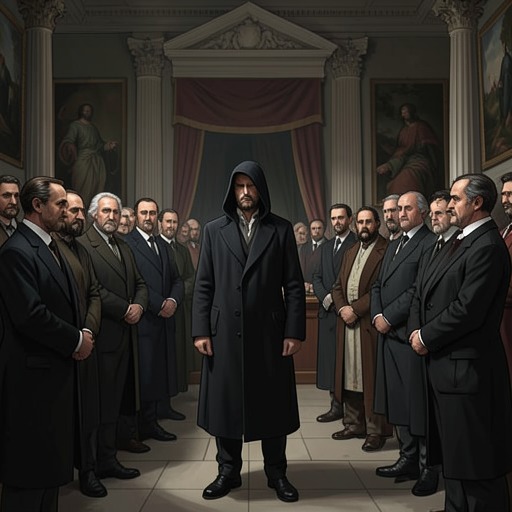
Mordecai’s refusal to bow to Haman
Book of EstherMordecai’s refusal to show Haman the customary respect ordered by Ahasuerus is presented as the act that turns a courtly slight into a threat against the Jews throughout the Persian Empire. The commentator argues that the gesture was not required by religious fidelity: Mordecai could, and should, have complied with the king’s civil command. Yet the refusal and its consequences also illustrate the book’s central theological claim that human beings act freely and remain accountable, while God’s providence can make even their errors serve purposes beyond their knowledge.
The Royal Command and the Refusal
Haman had been promoted above the other princes, and Ahasuerus ordered the king’s servants to bow and show him reverence. The commentator reads this as a demand for civil honor, not divine worship. He stresses that the narrative describes Mordecai as refusing to stand or even move when Haman passed. For the commentator, that detail makes the nature of the slight plain: it was a withholding of ordinary public respect, not a refusal to participate in an explicitly religious rite.
The distinction matters because the king’s command made the refusal more than a private breach of courtesy. Other servants noticed Mordecai’s conduct and challenged him for violating the royal order; they then reported the matter to Haman. In the commentator’s account, the command itself helped expose Mordecai and made his disobedience legible as a breach of royal authority. Without it, he might have escaped notice. The episode thus places courtly custom, the king’s law, and religious duty in the same political setting, while the commentator insists that the evidence supports compliance with the first two rather than resistance in the name of the third.
The Commentator’s Judgment
The commentator disputes defenses of Mordecai offered by earlier interpreters. One proposed defense was that Haman, as an Amalekite, could not properly be honored by a Jew. The commentator replies that the biblical command to destroy the Amalekites applied to Israel as a nation in its own land, not to a Jewish captive serving in the Persian court. He also observes that the story does not establish that Haman’s ancestry gave Mordecai a valid reason to withhold civil respect.
Another defense treated the required reverence as idolatrous. The commentator finds no evidence for that reading in the command, which he understands as requiring a bow and ordinary deference to a royal favorite. He argues that explanations based on Haman’s supposed claim to divine honors, or on a general danger that civil respect might be mistaken for worship, go beyond what the narrative says. Even if someone feared such a misunderstanding, he suggests, the proper response would have been to make the intention of the gesture clear rather than to refuse what was lawfully due.
The commentator further compares Mordecai’s conduct with forms of deference that biblical figures showed to rulers and superiors. He invokes Esther’s own actions: she followed Mordecai’s counsel, approached the king, and later fell at Ahasuerus’s feet while pleading against Haman’s decree. In his view, this contrast weakens the attempt to claim that Mordecai’s refusal was demanded by their shared religious identity. The text gives no decisive account of why Mordecai refused; it only suggests that he connected his Jewish identity with his decision. The commentator therefore distinguishes a possibly sincere motive from a sound judgment: good intention, he argues, does not turn error into duty.
From Personal Offense to National Peril
The narrative’s stated sequence gives the refusal grave consequences. Haman became enraged when he saw that Mordecai would not bow or show him reverence. He judged it insufficient to punish Mordecai alone and sought to destroy the Jews throughout Ahasuerus’s kingdom. The commentator rejects the claim that Haman acted because he assumed every Jew shared Mordecai’s refusal; he says that explanation is not supported by the stated reason. In the account he emphasizes, the visible slight, Mordecai’s Jewish identity, and Haman’s decision to widen his vengeance form the causal chain.
The commentator consequently holds Mordecai responsible for the natural effects of what he calls ignorance of duty, even though providence later prevents the threatened destruction from being carried out. He generalizes the danger: an ill-informed Christian’s defiant treatment of those in authority may bring hostility not only upon that person but upon a wider community. This is the commentator’s moral application of the episode, rather than a claim that Haman’s threatened violence was justified. Haman’s response remains the deliberate escalation that makes one courtier’s refusal a danger to an entire people.
The political setting sharpens that judgment. Haman represented the Jews to the king as a dispersed people whose laws differed from those of other nations, and he portrayed that difference as a threat to royal interests. The commentator distinguishes obedience to civil law from compliance with human religious institutions: he argues that the Jews were bound to seek the peace of the land where they lived, but not to abandon God’s commands. In his reading, however, Mordecai’s refusal to give civil respect was not the same as faithfully resisting an imposed religious rite. The episode therefore turns on a boundary the commentator considers essential: religious distinctiveness does not, by itself, authorize disobedience in matters of ordinary civil deference.
Human Responsibility and Providence
The commentator does not treat providential use as exoneration. Mordecai’s ignorance and refusal could contribute to the danger, while God’s providence could still direct events toward the eventual deliverance of the Jews. The same action may therefore be understood in two ways: as a freely chosen human act for which the actor bears responsibility, and as an event incorporated into a divine purpose. The commentator presents the tension not as a puzzle solved by excusing Mordecai, but as a truth that human understanding cannot fully reconcile.
That argument connects the court incident to the larger providential pattern of the book. The commentator says that the royal command, the disclosure that Mordecai was Jewish, and the resulting danger all served a purpose beyond the intentions of the people involved. Such claims do not erase the distinction between the actors’ motives and the outcome: Haman seeks vengeance, while Mordecai acts according to a judgment the commentator considers mistaken; neither thereby ceases to be accountable. Providence, in this account, is not approval of wrongdoing but the overruling of actions whose agents pursue their own ends.
Narrative and Thematic Significance
The refusal is a turning point because it links a specific act of disrespect to the collective peril of the Jews. Its force in the commentator’s reading lies partly in its small scale: Mordecai does not stage a public argument or explain his reasoning in the cited passage; he simply fails to rise or move as Haman passes. The servants’ attention transforms that gesture into a report, the report reaches a powerful favorite, and Haman expands his grievance into a plan against an entire people.
The episode also serves as a warning against reshaping a scriptural account to protect a favored figure. The commentator criticizes interpreters who, in his view, force unsupported explanations onto the text rather than admit that a person of faith may have acted wrongly. Mordecai’s later significance and the Jews’ eventual deliverance do not, in this argument, prove that every earlier choice was approved. The refusal remains both an action with serious human consequences and an instrument within a providential history—a combination the commentator urges readers to acknowledge without converting error into virtue.